After Prop 215 passed in 1996, Terence Hallinan —the only District Attorney in California who endorsed it— had urged the Department of Public Health to get involved in implementation. In July, 2000, DPH began issuing registration cards to applicants who were SF residents and had bona fide physician approval. The cards conferred the right to buy cannabis at a dispensary and to cultivate for personal use or as a caregiver. Dennis Peron thought those rights had been conferred by Prop 215, and that registration systems were unnecessary and intrusive. Tod Mikuriya, MD, hoped the health department would get involved in data collection and foresaw “a great research opportunity.”
Before I left UCSF in 1999 to become the DA’s Public Information Officer I had broken the CBD story in Synapse, the internal weekly. (If you missed it: THC is not the only active ingredient in marijuana, its numerous chemical cousins include CBD —cannabidiol— which has anti-inflammatory and anti-seizure properties and is not intoxicating. I still haven’t heard from the Pulitzer people.)
Synapse was produced mainly by medical students. In July and August, when they were gone, the paper appeared monthly and I did some of the writing. I had used vacation time in ’99 to attend the International Cannabinoid Research Society meeting, and it provided a perfect hook for a Synapse story. UCSF pharmacologist Lester Bornheim had presented a paper on cannabidiol which gave me a local angle and a platform to start preaching the gospel of CBD back in the US of A.
I also interviewed and wrote about Dr. Geoffrey Guy, the British pharmaceutical pioneer who was developing cannabis-based medicines with the approval of the Home Office. Guy had swayed the authorities by overcoming their objections to smoking and “euphoria” (getting high). His company would produce a cannabis extract that could be applied by spraying under the tongue. And users would not get high because the intoxicating THC in his plants would be negated by an equal amount of CBD, which was then considered a “minor” cannabinoid. Guy had obtained his CBD-rich “genetic library” (seeds) from renowned American expats, Rob Clarke and Dave Watson, who had traveled widely to collect them and had been breeding plants in Amsterdam.
Guy didn’t think there would be any CBD beyond trace amounts in the plants being grown back in California. He explained that they had all been bred for generations (of plants and people) to maximize THC content, which minimizes CBD production due to a genetic either/or. I hopefully maintained that the hills were full of hippies who saved seeds from any plant that produced an unusual effect, and some CBD was bound to turn up. The real problem was that no analytical labs were testing marijuana in the year of our Lord 1999.
Back home I reported to Dr. Mikuriya and we planned to run a front-page story about Guy’s strategy and the findings being reported to the International Cannabinoid Research Society. We lightheartedly referred to our publicity effort as “Project CBD.” Then I accepted the job at the DA’s office and we put the journal on hold.
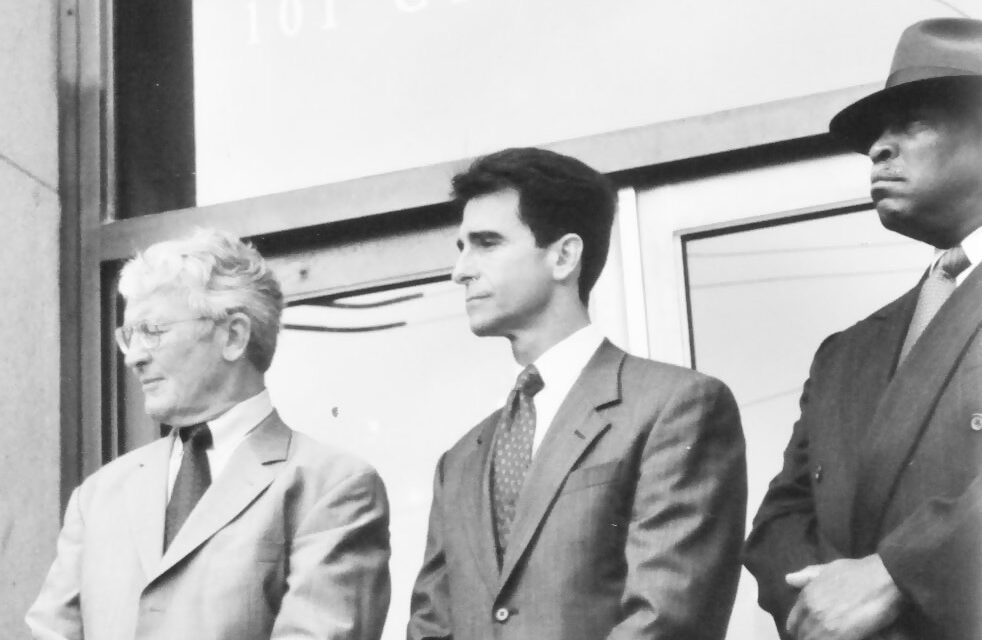
For dispensary operators and many activists it was a great day in San Francisco when the Department of Public Health began issuing registration cards. There was a ceremony outside the old greystone DPH office at 101 Grove Street and speeches by the director, Mitch Katz, MD, and District Attorney Hallinan, and Police Chief Earl Saunders, and Supervisor Mark Leno and others. The first card was issued to Wayne Justmann, the widely respected organizer of the Patients Resource Center on Divisadero. He had been living with HIV for many years and still is, thanks to protease inhibitors. A crowd of pot partisans and Health Department workers cheered heartily.
From Kayo’s speech: “One danger of the card system is that it will create two tiers of legitimacy in the eyes of law enforcement. That must not be allowed to happen. And the civil liberties implications of registering are obvious. Marijuana is still illegal under federal law…
“Last month the health department co-sponsored a conference at which the leading researchers updated doctors and other health professionals on the work that’s being done. Far in the lead is an English company that is breeding plants strains with different components for use in clinical trials. This company has full government support.
“We have the San Francisco Department of Public Health and what the scientists call ‘the crude plant.’ We also have the protections offered by Prop 215 and a potential database unequalled anywhere. We can begin by tracking how many patients are using cannabis for what conditions, and what results they are getting. At some point we can provide an analytical chemist so that dispensaries, patients and growers can determine the cannabinoid content of their plants.
“We can encourage cultivation of diverse strains for use in N-of-1 trials. That’s scientific jargon for a trial in which a single patient uses various strains of cannabis over set intervals of time and reports the effects to a doctor. And we can collect and collate data from doctors conducting these trials, transforming all our so-called ‘mere anecdotal evidence’ into sound epidemiological data.”
Soon after the kick-off of the registration program I paid a visit to the DPH Assistant Director, Josh Bamberger, MD, to suggest that the department begin testing cannabis being sold at San Francisco dispensaries. He said that their budget was stretched thin, and couldn’t the DA’s office persuade the police to use their lab for this important purpose? I thought but didn’t say, “Don’t be ridiculous.” I don’t recall warning Bamberger —as the shrewd founders of Steep Hill, the industry’s first private-sector lab would warn consumers in 2007— that mold on cannabis sold in dispensaries could be deadly to AIDS patients. (I was aware that it was a longshot danger, but they were thinking like entrepreneurs with a business to promote.)
Nor did I have the foresight to say that the lab could turn into a big moneymaker for the Department for Public Health. I didn’t realize that the medical marijuana movement would morph into “The Legal Cannabis Industry,” and, in due course, make cannabis safe for capital. I don’t know if I could have convinced Dr. Bamberger to become a dealer in 2001, but I fault myself for not trying.
My next bright idea as the DA’s liaison to the medical marijuana community was that The City and County of San Francisco should grow its own.