“Most journalists also don’t know about Heywood Broun (1888-1939), one of the nation’s best-paid columnists who risked his own financial stability to create The Newspaper Guild in 1935 to help those reporters making one-hundredth of his salary. –Walter Brasch in Counterpunch
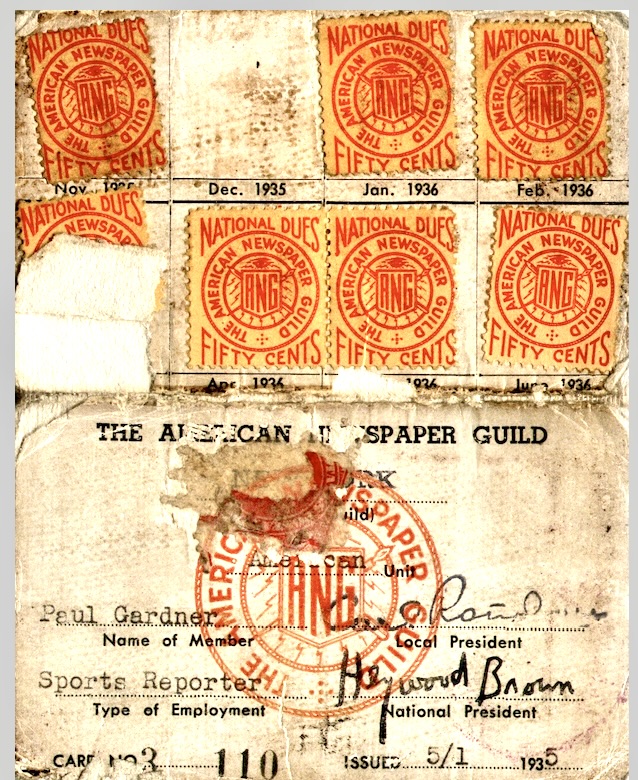
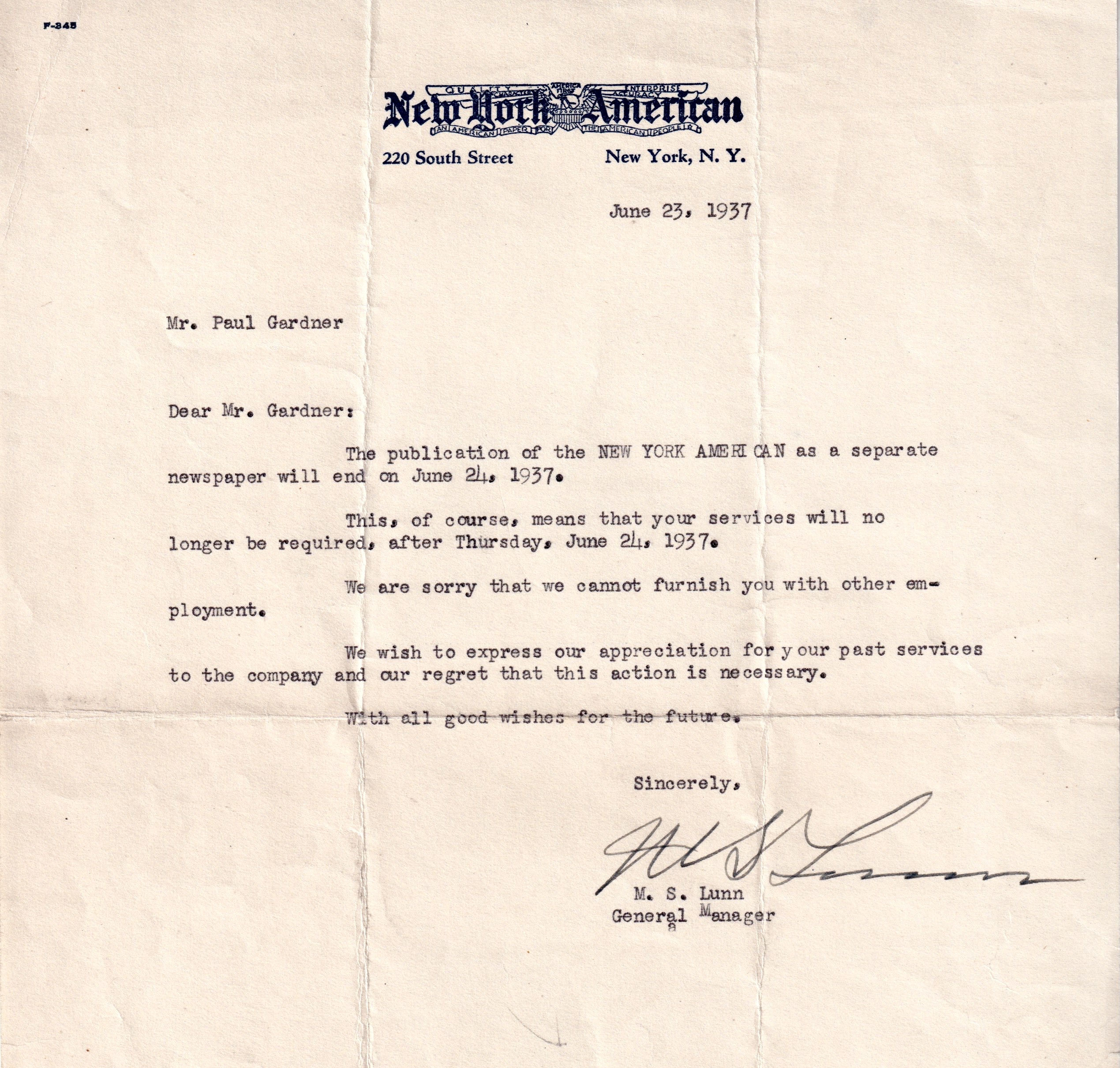
The number of newspapers in NYC was at its peak when he started out as a copy boy at the Brooklyn Eagle in the early 1920s. By the early ’50s the number of dailies was down to six. Paul Gardner became a publicist for Spalding Sporting Goods and the Ladies Professional Golf Association. He helped make women’s golf a major sport in terms of newspaper coverage.
From good old Wikipedia: “Conservative Democratic President Grover Cleveland was concerned that a labor holiday on May 1 would tend to become a commemoration of the Haymarket affair and would strengthen socialist and anarchist movements that backed the May 1 commemoration around the globe. In 1887, he publicly supported the September Labor Day holiday as a less inflammatory alternative, formally adopting the date as a United States federal holiday through a law he signed in 1894…
“In the year after World War 2 ended, 4.3 million US workers went out on strike: auto workers, electric workers, meatpackers, steel workers, coal miners, railroad engineers…
The bosses clamped down. “The labor movement was undercut in 1947 by passage of the Taft-Hartley Act, which banned strikes by one union in solidarity with another.Though it was enacted by the Republican-controlled 80th Congress, the law received significant support from congressional Democrats, many of whom joined with their Republican colleagues in voting to override Truman’s veto. Among the practices prohibited by the Taft–Hartley act are jurisdictional strikes, wildcat strikes, solidarity or political strikes, secondary boycotts, secondary and mass picketing, closed shops, and monetary donations by unions to federal political campaigns. The amendments also allowed states to enact right-to-work laws banning union shops. Enacted during the early stages of the Cold War, the law required union officers to sign non-communist affidavits…”
The creation of Loyalty Day in 1955 (which didn’t catch on because government offices stayed open), and the addition of “under God” to the pledge of allegiance (which broke the familiar rhythm of what we recited every morning) remind us that today’s fascism is a continuation and something different at the same time. Like H2O turning from water to steam at 212º Fahrenheit.
Instead of a Parade
In 1970 the leaders of the AFL-CIO canceled the Labor Day parade that US union members had been taking part in since 1894. (Labor Day marches were being held in 30 states before Congress gave them stamp of federal approval.) On September 7, 1970, the union leaders partied at the White House.

In a front-page story in the New York Times, Sept. 7, 1970, Christopher Lydon noted:
… In other election years, Democratic presidents have gone to Detroit to join the unions’ celebration of Labor Day. But this year, when the auto workers in Detroit are preoccupied with contract bargaining, Mr. Nixon invited the traditionally Democratic labor movement to mark the day with him.
George Meany, the president of the American Federation of Labor and Congress of Industrial Organizations, was a special guest of honor. Mr. Nixon compared him to Vince Lombardi, the late football coach, as a “man of character.” Mr. Nixon also called Mr. Meany “a distinguished labor statesman, a man who stands for the best in free labor.”
“In this time of turbulence at home and abroad,” the President said, “when the old virtues and the good virtues— many of the good ones—are being brought under question, this man has stood like a pillar in a storm—strong, full of character, devoted to his church, devoted to his family, devoted to his country.”
Mr. Meany, a consistent and vocal supporter of the Presi dent’s policy in Indochina, has been critical of the Administration’s economic policies. He has said that domestic issues will be decisive when union members go to the polls in November.
In response to Mr. Nixon’s toast tonight, Mr. Meany suggested, in a review of Presidents he has known, that this President, like the others, was doing “the best he can for the American people.”
He said that no matter how political Presidents have been —“and let me tell you,” he said, “Franklin Roosevelt was just as tricky a politician as anyone who bore the name of ‘Tricky Dick’ could be, and Lyndon was no slouch at politics—they have all wanted to be the best President they could be.”
The A.F.L.‐C.I.O, the nation’s largest union, was heavily represented at the dinner—by most of the constituent union presidents who form its 35‐man executive council and by more than a dozen of the union’s key staff members. The International Brotherhood of Team sters, the second‐largest union, was represented by its acting president, Frank E. Fitzsimmons, and its secretary‐treasurer, Thomas Flynn.Leonard Woodcock, president of the United Automobile Workers, was invited to the dinner but did not attend.
The White House also invited 4,000 of the lower‐echelon officials and clerical staff mem bers in the Washington offices of labor organizations to “military torchlight tattoo” on the White House lawn after the dinner. Units from the military district of Washington gave musical and marching re‐enactment of important moments in American history.
Bonus Track
Labor Day is here again
the parade is off, in case you wondered
Union brother, this year we’re struttin’
Down at number Sixteen Hundred
To Guy Lombardo’s songs of struggle
Dinah Shore’s proud ballads of toil
For the boys in the mines and the girls on the lines
and the horny-handed sons of the soil
William Haywood vowed this day would come
Ain’t it a shame Big Bill ain’t alive
To see Rockefeller tango, he’s so graceful
Her old man’s in the building trades
Look, there’s Senators
There’s Jedgar Hoover
Him and Bill could talk over
All them old raids
Labor Day is here again
Mother Earth strains, ggnnashing her teeth
When’s that new world baby due, Baby?
Wish I could tell you more than just “Breathe…”