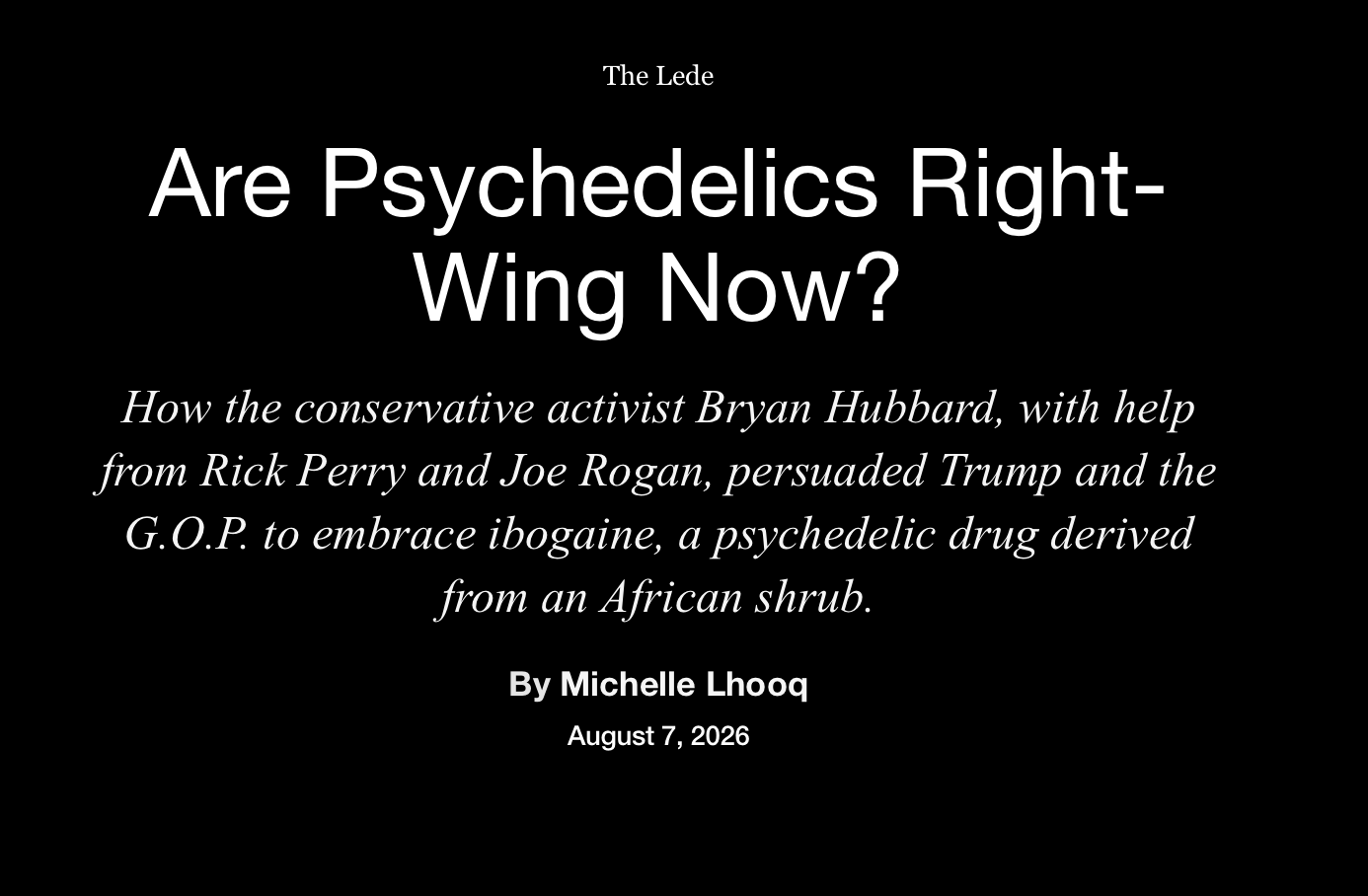
Strange headline on a big New Yorker story: “Are Psychedelics Right-Wing Now?”
So, what else is new? Leary and Alpert taught courses at Harvard in a field called “Social Relations.” Their political message was “Turn on, tune in, drop out.” There’s nothing “left-wing’ about that. It points people inward.
No drug is inherently right-wing or left-wing, it’s a matter of political “set and setting.” In the US in the 1920s and ‘30s, state prohibition laws were used to bust Mexicanos and Negroes. In the ‘60s the herb was favored by anti-war GIs and students. It was the drug that got passed around –shared. Your friends could grow their own, bypassing Big Pharma…But now it’s Cannabis, a heavily-taxed commodity that soothes us like the drug called “soma” pacified citizens in Huxley’s Brave New World. Legal cannabis makes life seem more tolerable while the Earth slowly dies. (Get me some 5 milligram sours when you go to the dispensary.)
The NYer story by Michelle Lhooq is summarized in a subhead: “How the conservative activist, Bryan Hubbard, with help from Rick Perry and Joe Rogan, persuaded Trump and the GOP to embrace ibogaine, a psychedelic drug derived from an African shrub.”
Lhooq describes Rick Perry, the former governor of Texas, promoting “Americans for Ibogaine” at a luncheon attended by some very rich and influential Houstonians. Perry recounted “the chain of extra extraordinary events that led President Donald Trump to sign an executive order, in April, expediting FDA approval of psychedelic therapies. ‘I am a very, very strong man of faith,’ Perry said. ‘It couldn’t have happened without some divine intervention.’ Then he bowed his head and blessed the meal.”
Lhooq’s camera pulls back for a long shot: “Increasingly, it is conservative leaders who are embracing research into psychedelics. Ibogaine, in particular—a psychedelic drug derived from an African shrub—has become a cause célèbre for the American right. The drug’s relative obscurity has allowed its champions to shake off the baggage of the nineteen-sixties, and to position its use, not as hippie hedonism but as a medical intervention compatible with patriotic duty and Christian faith. This framing has been remarkably effective at winning the support of red-state governments and securing substantial funding for psychedelic research.”
Lhong identifies Bryan Hubbard, a Kentucky lawyer who specialized in workers’-compensation cases, as “the major force behind the Ibogaine movement.”
This ran in the Wall Street Journal Sept. 5: